Now Open: Neuroaffirming Residential Treatment for Autistic Teens
New Neuroaffirming Program for Autistic Teens
Learn More ×Call for a free assessment: 1-800-665-4769
If your teen is having suicidal thoughts, you’re facing one of the most frightening moments a parent can have. Evolve provides evidence-based suicidal ideation treatment in safe, structured environments built specifically for teens, helping them move from crisis to lasting stability.

Suicidal ideation rarely develops because of a single event. Every teen has a different story, which is why we begin with a comprehensive assessment to understand what they’re experiencing and what may be contributing to their distress. From there, we create a personalized treatment plan that reflects their unique needs while keeping safety at the center of every step.
Recovery is about more than reducing suicidal thoughts. It’s also about helping teens rediscover hope and reconnect with the people and experiences that give life meaning. As treatment progresses, we help teens strengthen healthy coping skills, rebuild important relationships, and gain confidence in their ability to move forward.
of the teens we treat enter our programs experiencing suicidal ideation
leave treatment with zero or only mild symptoms
of our teens report overall improvement during treatment

Families deserve to know how their teen is progressing throughout treatment. That’s why we use the Kiddie Computerized Adaptive Test (K-CAT) from admission through discharge. This clinically validated assessment helps us measure changes in your teen’s mental health over time and better understand how those changes affect everyday life.
The K-CAT is completed at regular points during treatment, giving us an objective way to monitor your teen’s progress and make adjustments when needed. It helps us see how symptoms are changing while also measuring improvements in day-to-day functioning. You’ll receive clear updates along the way, so you can better understand your teen’s progress and feel informed about the next steps in their care.
The K-CAT assessment measures the presence, severity, and functional impact of suicidal thoughts on daily life, including school and relationships.
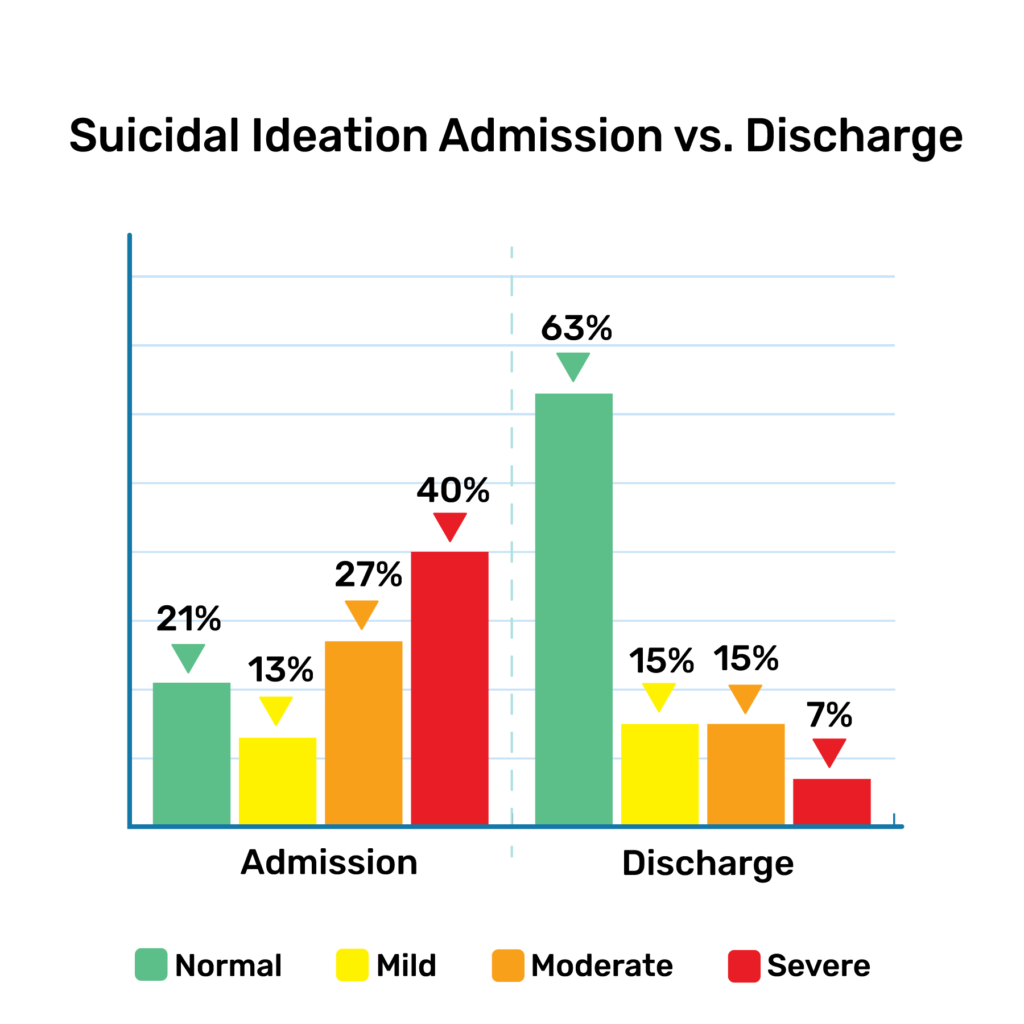
At admission, 67% of residential clients scored in the moderate or severe range, with 40% in the severe range alone, reflecting deep hopelessness and significant difficulty managing school, relationships, and everyday life.
As shown in the chart, the percentage of clients scoring in the “severe” range decreased significantly, from 40% at admission to 7% at discharge, and the “moderate” range dropped from 27% to 15%. In addition, the percentage of clients in the “normal” range increased significantly from 21% to 63%.
Overall, suicidality scores decreased by 49% on average from admission to discharge, showing meaningful improvement during residential treatment.
When you choose Evolve, you are choosing a program that combines compassionate care with proven results. Every day in treatment is purposeful, guided by evidence-based therapies and informed by real-time progress tracking. We continually adjust each teen’s care to ensure they are moving forward, building the skills, confidence, and resilience they need to thrive long after treatment ends. To learn more about Evolve’s clinical outcomes studies and the effectiveness of our programs, visit our outcomes page and download the full report.
24/7 Support & Supervision
Full Day Program
After School Program
Flexible Online Care
Get a free assessment with our admissions team. Call to speak with someone directly or fill out our form online to get started.
Effective suicidal ideation treatment isn’t about guesswork. It’s grounded in therapeutic approaches that research has proven to reduce suicide risk and treat the underlying conditions that drive suicidal thoughts. At Evolve, we use evidence-based modalities that have been specifically studied in adolescent populations and shown to produce measurable outcomes. These include:

Recognizing suicidal ideation early can be lifesaving, but the signs aren’t always obvious. Some teens openly express thoughts of suicide, while others communicate their distress more indirectly through changes in behavior, mood, or social functioning. Warning signs to watch for include:
Professional evaluation is necessary for any form of suicidal ideation, ranging from passive expressions such as “I wish I could disappear” to explicit plans of ending one’s life. Immediate assistance should be sought if your teenager communicates thoughts of suicide or has a history of suicide attempts or self-harm. It’s also warranted if they possess a specific plan along with access to lethal means, or if they undergo a mental health crisis that cannot be safely managed within the home
For emergencies, contact 988 (the Suicide & Crisis Lifeline), go to the closest emergency room, or dial 911. In concerning but non-emergency scenarios, such as learning your teen experiences suicidal thoughts without an active plan, reach out to a mental health specialist for a prompt assessment. Connecting your teen with appropriate care early can stop the situation from escalating and provide vital support prior to a full crisis.
Suicidal ideation refers to thoughts about ending one’s life. Passive ideation includes thoughts like “I wish I weren’t alive,” while active ideation involves specific plans or intent to attempt suicide. Both require clinical attention, though active ideation with a plan represents higher immediate risk. The right treatment response depends on the severity, frequency, and context of these thoughts.
Suicidal ideation refers to thoughts, while a suicide attempt is a self-directed action with intent to die. Some teens experience suicidal thoughts without ever acting on them; others move from ideation to planning to attempt. This also differs from non-suicidal self-injury (NSSI) like cutting, which is used to cope with emotional pain rather than end one’s life, though NSSI still increases future risk and requires treatment. A history of attempts significantly raises the risk of future attempts, which is why these teens typically need intensive, ongoing care.
Residential treatment may be the right choice if your teen needs more support than can safely be provided at home. This is often the case after a suicide attempt, when suicidal thoughts become persistent, or when outpatient treatment is no longer enough. Our admissions team completes a comprehensive clinical assessment to recommend the level of care that best fits your teen’s needs, never more or less than is appropriate.
Evolve treats teens ages 12 to 17 for suicidal ideation and related mental health conditions, with age-appropriate therapies, peer groups, and family interventions built for the challenges of adolescence.
We work to expedite admissions, often completing assessments, insurance verification, and placement within 24 to 48 hours, with same-day or next-day admission possible in some cases. Our team is available 24/7 to begin the process immediately. If your teen is in immediate danger, go to the nearest emergency room or call 988. Once stable, we can facilitate transfer to our program if appropriate.
Most teens stay between 30 and 90 days, though duration depends on clinical progress rather than a fixed timeline. Teens step down to a lower level of care once they’ve achieved safety, developed coping skills, and made progress on underlying issues. Many transition to PHP or IOP for a gradual, supported return home.
Safety is our top priority. Our centers provide 24/7 awake staff supervision and secure environments with restricted access to means of self-harm. We also conduct regular safety checks and provide immediate psychiatric and medical care, along with individualized safety plans. Staff are trained in risk assessment and crisis intervention, and our supportive peer community helps reduce isolation, a key protective factor against suicidal behavior.
Family involvement is an important part of treatment. Parents participate in family therapy, receive regular updates, and learn practical ways to support their teen throughout recovery.
Most commercial insurance and many Medicaid plans cover treatment for suicidal ideation under mental health parity laws. Coverage varies by plan, so our admissions team can help you verify your benefits at no cost.
You don’t have to face this alone. Evolve Treatment Centers offers evidence-based suicidal ideation treatment and proven outcomes to help your teen heal in a safe, compassionate environment. Contact our admissions team 24/7 for a confidential assessment, insurance verification, and guidance on the right next step, whether your teen needs immediate care or you’re just exploring options. Your teen’s life is worth fighting for. Let us help you fight for it.