Call for a free assessment: 1-800-665-4769
When everyday routines turn into daily battlegrounds, it’s easy to feel like you’ve failed as a parent, but you haven’t. Oppositional Defiant Disorder (ODD) and Conduct Disorder are among the severe behavioral issues we treat, and our family-focused behavioral health treatment helps your teen break the cycle of conflict, rebuild trust, and equip your teen with skills that last.
Oppositional Defiant Disorder (ODD) is more than just typical teenage rebellion or “bad behavior.” It is a clinical diagnosis marked by an ongoing pattern of anger, defiance, and conflict with authority figures that impairs your teen’s daily life. At Evolve, we approach ODD not as a lack of discipline, but as a severe difficulty in emotional regulation, often driven by underlying mental health struggles like anxiety or trauma.
To break the cycle of conflict, we start with a comprehensive assessment to understand the full picture, including family dynamics and any co-occurring conditions. We then build an individualized plan that combines individual therapy, skill-building groups, and psychiatric care (when clinically indicated) to help your teen recognize triggers and develop healthier habits. Because family involvement is the cornerstone of effective ODD treatment, we partner with you to develop calm, effective responses to defiance, and collaborate with your teen’s school to ensure a unified support system.
of our ODD teens come to us actively battling elevated symptoms
of all ODD teens experienced reduction in symptoms
of our teens report overall improvement during treatment.

Evolve Treatment Centers uses an advanced, research-backed tool called the Kiddie Computerized Adaptive Test (K-CAT) to track your teen’s progress. The K-CAT helps our clinicians identify and track ODD, conduct disorder, and related concerns, so your teen’s care plan reflects what they’re actually experiencing. This validated assessment specifically evaluates oppositional behavior, anger, and related emotional concerns. Because the questions adapt in real time to your teen’s responses, the test is highly efficient, providing our team with vital clinical data without overwhelming your teen.
We administer the K-CAT at admission, at regular intervals during treatment, and at discharge. This timeline allows us to objectively measure symptom changes and functional improvements throughout their stay.
For parents, this data provides concrete evidence of progress. Our clinical and academic teams use these insights to adjust treatment plans in real time, ensuring your teen receives the most effective care. Ultimately, this objective data gives your family confidence that the treatment is working, while guiding our decisions about stepping down to lower levels of care and planning for aftercare.
The K-CAT tracks both symptom severity and how those behaviors impact your teen’s daily life. Many teens enter our program experiencing significant behavioral distress and real-world impairment. At admission, 35% of teens with ODD score in the moderate or severe range (26% moderate and 9% severe), and only 28% score in the normal range. By discharge, the picture looks very different. 65% of teens score in the normal range, more than double the share at admission, while moderate scores fall to 8% and severe scores to just 1%.
These clinical gains translate directly into everyday life. Teens leave our programs better equipped to manage their anger, communicate respectfully, and follow household expectations. Just as importantly, they begin repairing relationships damaged by past behavior, while parents gain the confidence to set healthy boundaries and respond calmly to defiance.
While every teen’s journey is unique and shaped by family involvement, the outcomes are clear. Moving from 35% of teens in the moderate or severe range at admission to 9% at discharge shows what structured, evidence-based treatment can do. It leads to meaningful and lasting improvement for the whole family.
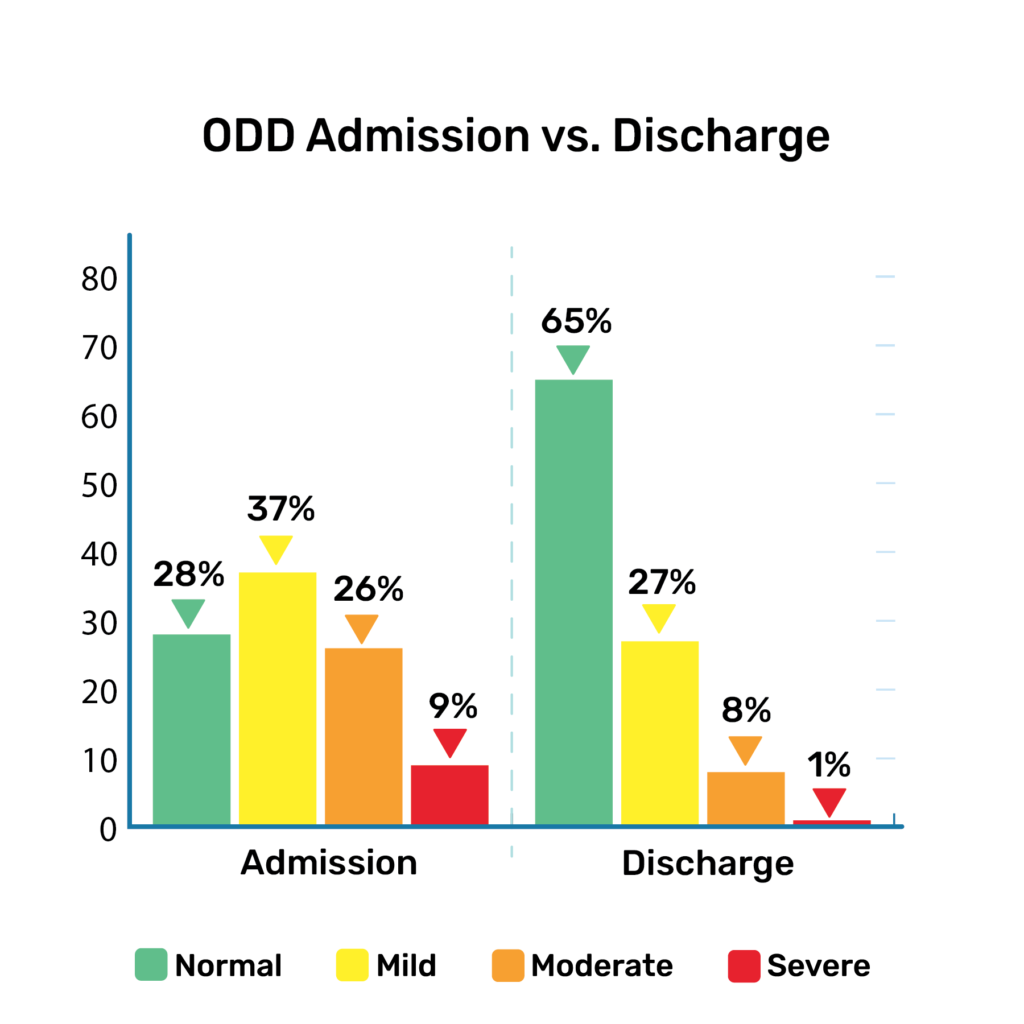
When you choose Evolve, you are choosing a program that combines compassionate care with proven results. Every day in treatment is purposeful, guided by evidence-based therapies and informed by real-time progress tracking. We continually adjust each teen’s care to ensure they are moving forward, building the skills, confidence, and resilience they need to thrive long after treatment ends. To learn more about Evolve’s clinical outcomes studies and the effectiveness of our programs, visit our outcomes page and download the full report.
24/7 Support & Supervision
Full Day Program
After School Program
Flexible Online Care
Get a free assessment with our admissions team. Call to speak with someone directly or fill out our form online to get started.
Evolve’s treatment approach is grounded in therapies with strong research support for reducing oppositional and defiant behavior. We tailor each teen’s plan to their specific needs, drawing from a range of proven methods. Medication may also be considered when co-occurring conditions like ADHD, anxiety, or depression contribute to behavioral symptoms. These therapies are used to treat ODD, conduct disorder, and other severe behavioral challenges, with each plan tailored to your teen’s needs.

Recognizing ODD can be challenging because many symptoms overlap with normal adolescent development. What sets ODD apart is the intensity and duration of the behavior, along with the real impairment it causes. Watch for these warning signs happening consistently for at least six months:
Consider professional treatment if your teen’s defiant behavior is persistent, severe, or escalating despite your best efforts. If these behaviors are causing significant family stress, leaving parents and siblings feeling like they are constantly walking on eggshells, it is time to seek a professional evaluation. You should also seek immediate help if you feel unable to manage the behavior safely, or if you see serious warning signs like aggression toward people or animals, property destruction, frequent school suspensions, or co-occurring depression and anxiety.
Even if things haven’t reached a crisis level, professional support can help if you are feeling stuck or unsure of how to respond. A comprehensive assessment can clarify whether your teen meets the criteria for ODD and identify exactly what is driving the behavior. From there, a qualified professional can point you toward the right level of care. Early intervention is critical; it improves treatment outcomes and can prevent ODD from progressing into more serious conduct problems down the road.
Typical teen rebellion may involve occasional defiance or testing boundaries as part of growing independence. ODD involves a persistent pattern of angry, defiant, or vindictive behavior that lasts at least six months and significantly affects life at home or school.
ODD primarily involves ongoing defiance, arguments with authority figures, and anger or irritability. Conduct disorder involves more serious behaviors that violate the rights of others or major rules. While the conditions are different, some teens with ODD may later develop conduct disorder, though this does not happen in every case.
Some teens with ODD may later develop conduct disorder, but this progression is not inevitable. Early treatment can address behavioral concerns, strengthen family relationships, and help teens develop healthier ways to manage emotions and respond to conflict.
Choose a calm moment and approach the conversation with empathy rather than blame. Share what you have noticed, explain why you are concerned, and give your teen space to share their perspective. Framing treatment as support rather than punishment can also make it easier for your teen to accept help.
Teens can learn to recognize when anger or frustration is building and use strategies to manage those emotions before they escalate. Techniques such as deep breathing, grounding, taking a break, and practicing healthier communication can help. Therapies such as CBT and DBT can teach these skills and help teens apply them in everyday situations.
Treatment depends on your teen’s symptoms and individual needs. Therapy can help teens manage anger, regulate emotions, and respond to conflict more effectively, while family involvement can improve communication and reduce conflict at home. Evolve offers multiple levels of care so treatment can match the severity and needs of each teen.
Many insurance plans cover medically necessary behavioral health treatment for conditions such as ODD, but coverage varies by plan and level of care. Evolve’s admissions team can verify your benefits, explain your coverage, and help you understand potential out-of-pocket costs before treatment begins.
Treatment length depends on your teen’s symptoms, progress, individual needs, and insurance authorization. Some teens may need several weeks of residential care, while others may benefit from a longer stay. Evolve’s clinical team monitors progress and recommends a lower level of care when it is safe and appropriate.
Before discharge, Evolve works with families to create an aftercare plan that supports continued progress. Depending on your teen’s needs, this may include ongoing therapy, psychiatric care, school support, or a transition to a lower level of care. Families also receive guidance on maintaining progress and recognizing when additional support may be needed.
You don’t have to navigate this alone. Evolve offers the clinical expertise and family support your teen needs to build healthier coping skills and a brighter future, whether that means residential care or outpatient support.
Our admissions team is ready to answer your questions, verify your insurance, and schedule a confidential assessment. Reach out today and take the first step for your teen and your family.