Call for a free assessment: 1-800-665-4769
When your teen has experienced trauma, you may notice nightmares, avoidance, emotional outbursts, or withdrawal from things they once loved. PTSD affects how your teen’s brain processes safety and daily life. Evolve provides specialized, evidence-based treatment to help them heal.

Trauma affects teenagers differently than adults because their brains are still developing, especially in the areas that regulate emotion and threat response. That’s why we start by understanding your teen’s trauma history and how their symptoms are affecting school and family life, then build from a comprehensive clinical assessment rather than a one-size-fits-all model.
From there, we create a personalized treatment plan combining trauma-focused therapy, psychiatric support when needed, and family involvement. Skill-building is also woven throughout, helping your teen regain a sense of safety and control. Whether they need residential care or outpatient support, you’ll work with a dedicated team of therapists, psychiatrists, and family specialists who keep you informed every step of the way.
of the teens we treat show possible to definite signs of PTSD at admission
decrease in teens scoring in the possible-to-definite PTSD range from admission to discharge
of our teens show no evidence of PTSD at discharge

We believe in accountability and transparency. That’s why Evolve uses an advanced, research-backed assessment tool called the Kiddie Computerized Adaptive Test (K-CAT) to track your teen’s progress throughout treatment. The K-CAT is a clinically validated measurement system that evaluates symptoms across multiple domains, including PTSD, anxiety and depression. Unlike traditional assessments that use the same questions for everyone, the K-CAT adapts in real time based on your teen’s responses, providing a more accurate and personalized picture of their symptom severity and functioning.
We administer the K-CAT at admission, regularly during treatment, and at discharge. This allows our clinical team to see exactly how your teen is responding to interventions and make data-driven adjustments to their treatment plan. It also helps us demonstrate measurable improvement. You’ll receive clear reports showing changes in symptom severity and daily functioning, so you can see the progress your teen is making. This commitment to measurement-based care means we’re not guessing about what’s working. We know, and we can show you.
The K-CAT PTSD assessment evaluates trauma-related symptoms such as intrusive memories, avoidance, negative mood changes, and heightened arousal, as well as how these symptoms affect daily functioning. It categorizes results based on the likelihood of PTSD: no evidence, possible, or definite or highly likely.
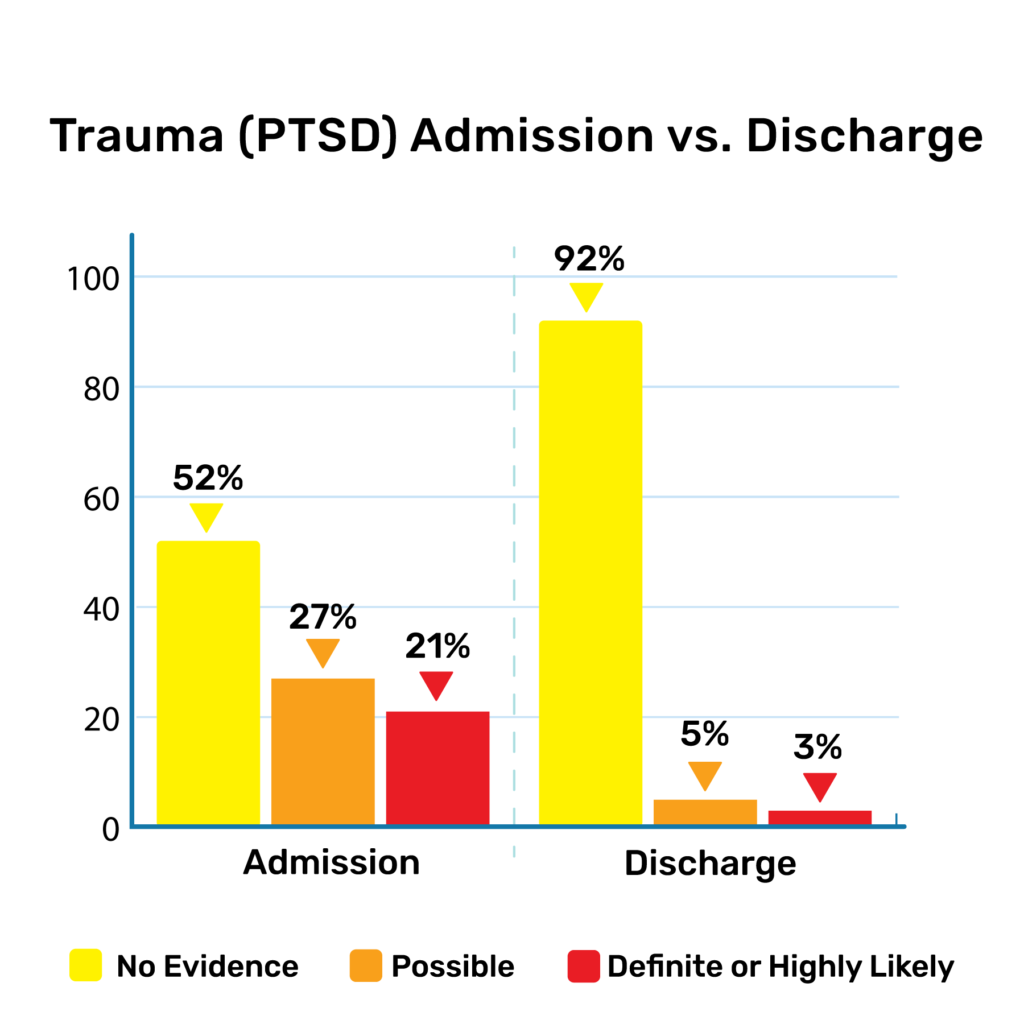
At admission, 48% of residential clients scored in the possible-to-definite range, with 21% in the definite or highly likely range alone, indicating significant trauma-related symptoms that interfered with daily functioning, relationships, and overall well-being.
As shown in the chart, the percentage of clients scoring in the “definite or highly likely” range decreased significantly, from 21% at admission to 3% at discharge, and the “possible” range dropped from 27% to 5%. In addition, the percentage of clients with “no evidence” of PTSD increased significantly from 52% to 92%.
Overall, these results demonstrate meaningful improvement in trauma-related symptoms during residential treatment, with teens developing healthier ways to cope, improving daily functioning, and feeling more connected to the people around them.
When you choose Evolve, you are choosing a program that combines compassionate care with proven results. Every day in treatment is purposeful, guided by evidence-based therapies and informed by real-time progress tracking. We continually adjust each teen’s care to ensure they are moving forward, building the skills, confidence, and resilience they need to thrive long after treatment ends. To learn more about Evolve’s clinical outcomes studies and the effectiveness of our programs, visit our outcomes page and download the full report.
24/7 Support & Supervision
Full Day Program
After School Program
Flexible Online Care
Get a free assessment with our admissions team. Call to speak with someone directly or fill out our form online to get started.
We use proven therapeutic approaches that research shows are effective for treating trauma and PTSD in adolescents. Your teen’s treatment plan will incorporate multiple methods tailored to their needs.

PTSD develops after exposure to actual or threatened death, serious injury, or sexual violence. Not every teen who experiences trauma will develop PTSD, but when symptoms persist for more than a month and interfere with functioning, professional evaluation is warranted. Here’s what PTSD can look like in adolescents:
If your teen has experienced trauma and you notice ongoing changes that affect their daily life, it may be time to seek professional support. Early intervention can help teens process what happened and develop healthier ways to cope before symptoms become more difficult to manage.
You don’t need to have all the answers or a formal diagnosis to reach out. If you’re concerned about your teen’s well-being, our admissions team can help you understand whether PTSD treatment is the right fit and guide you through the next steps.
Trauma refers to the event itself, while PTSD is a specific condition that can develop afterward. Not every teen who experiences trauma develops PTSD, many recover with time and support. PTSD is diagnosed when specific symptoms (intrusive memories, avoidance, negative mood changes, hyperarousal) persist for more than a month and significantly impair functioning.
PTSD can develop after events like assault, serious accidents, witnessing violence, sudden loss, or ongoing abuse. Not everyone exposed to trauma develops PTSD. Risk depends on factors like trauma severity, prior history, and support systems, while strong family relationships can help protect against it.
Treatment length depends on symptom severity and individual response. Residential care typically lasts 30 to 90 days, and PHP runs several weeks to a few months. IOP often continues two to three months, often followed by ongoing outpatient support. The goal is lasting recovery, not a fixed timeline.
Evolve’s adolescent programs typically serve ages 12 to 17. Our programming and environment are designed specifically around how trauma affects teens at this stage of development.
Most insurance plans cover a portion of residential, PHP, IOP, and outpatient care. Our admissions team verifies your benefits, explains your coverage, and helps you understand any out-of-pocket costs before treatment begins.
Teens often show irritability, anger, or reckless behavior instead of the fear and anxiety typically seen in adults. Because trauma occurs during a critical stage of development, it can also affect identity, peer relationships, and school performance, which is why treatment needs to be developmentally appropriate.
Yes. Untreated PTSD raises the risk of depression, anxiety, substance use, and self-harm. It can also affect emotion regulation, relationships, and academic performance. At Evolve, we treat all co-occurring conditions, not just PTSD symptoms alone.
It starts with a call to discuss your teen’s symptoms and history. If appropriate, we verify insurance and schedule a clinical assessment involving your teen, your family, and our psychiatric team. From there, we recommend a level of care and build an initial treatment plan, guiding you through every step.
Yes. Teens in residential and PHP programs attend our accredited on-site school, and we coordinate with their home school to keep credits on track. For IOP or outpatient care, we work around their regular school schedule and support any needed academic accommodations.
Watching your teen struggle with trauma and PTSD is painful, but you don’t have to navigate this alone. Evolve Treatment Centers has helped hundreds of teens process trauma, reduce symptoms, and rebuild their lives through specialized, evidence-based care. Recovery is possible, and it starts with a conversation, contact our admissions team today to learn how we can support your family every step of the way.