Call for a free assessment: 1-800-665-4769
Watching your bright and capable teen struggle to stay organized, manage their impulses, or keep up in school can be incredibly frustrating for both of you. Evolve Treatment Centers provides evidence-based support for teens with ADHD, tailored to their individual needs and offering the appropriate level of care and support at the right time.
of the teens we treat struggle with ADHD
of these teens experienced reduction in symptoms
of our teens report improvement during treatment

Evolve Treatment Centers uses a research-backed assessment tool called the Kiddie Computerized Adaptive Test (K-CAT) to track symptom severity and functional improvement throughout treatment. The K-CAT is a validated, adaptive measure that adjusts its questions in real time based on your teen’s responses. It provides precise data on core ADHD symptoms as well as co-occurring concerns like anxiety, depression, and behavioral challenges. Since it’s administered at admission, during treatment, and at discharge, we can quantify exactly how your teen is progressing, not just clinically, but in the areas that matter most to daily life, including school performance, peer relationships, family conflict, and self-regulation.
This data-driven approach means treatment decisions are guided by objective evidence rather than guesswork. If a particular intervention isn’t moving the needle on executive-function deficits or emotional dysregulation, we adjust the plan. Families receive regular updates on K-CAT scores and functional outcomes, so you can see in concrete terms how your teen is building the skills they need to succeed after discharge. Transparency and accountability are built into every stage of care.
The K-CAT ADHD assessment evaluates both symptom severity and functional impairment, capturing how core ADHD symptoms affect a teen’s daily life at school, at home, and with peers. Many teens enter treatment scoring in the severe or moderate range. By discharge, our outcomes data show substantial improvement, with fewer teens in the severe category and overall ADHD severity scores improving as a whole. These gains reflect real-world skill acquisition. Teens leave better equipped to manage their attention and regulate their impulses.
Because ADHD rarely exists in isolation, we also track co-occurring symptoms. Teens who enter treatment with co-occurring anxiety, depression, or behavioral issues tend to show parallel improvement in those areas as well, reflecting the value of integrated, evidence-based care. Our outcomes show that with the right combination of therapy, skill-building, family involvement and medication (when clinically indicated), teens with ADHD can achieve meaningful, lasting change.
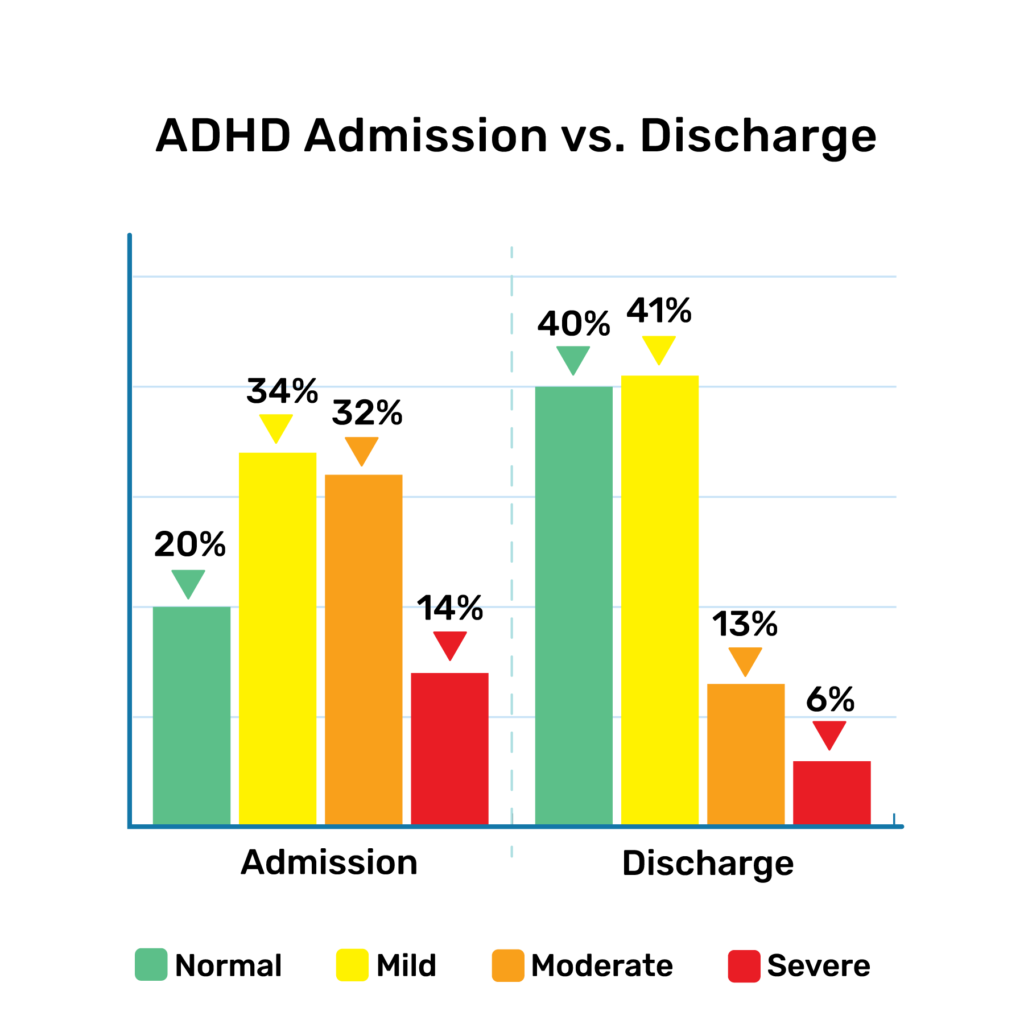
When you choose Evolve, you are choosing a program that combines compassionate care with proven results. Every day in treatment is purposeful, guided by evidence-based therapies and informed by real-time progress tracking. We continually adjust each teen’s care to ensure they are moving forward, building the skills, confidence, and resilience they need to thrive long after treatment ends. To learn more about Evolve’s clinical outcomes studies and the effectiveness of our programs, visit our outcomes page and download the full report.
24/7 Support & Supervision
Full Day Program
After School Program
Flexible Online Care
Get a free assessment with our admissions team. Call to speak with someone directly or fill out our form online to get started.
Evolve’s teen ADHD treatment is grounded in interventions with strong research support, combining therapy, skill-building, and medication management when appropriate into one cohesive, individualized plan.

ADHD symptoms in teens can look very different from those in younger children. Hyperactivity may be less obvious, showing up as internal restlessness or quiet fidgeting rather than constantly being on the move. At the same time, inattention and executive functioning challenges often become much more noticeable as academic and social demands increase. Watch for these warning signs, particularly if they happen consistently for at least six months and across multiple settings:
You should consider professional evaluation and treatment if your teen’s ADHD symptoms are affecting their daily life or making it harder for them to function at school, at home, or with others. When these challenges begin to affect your teen’s emotional well-being or overall quality of life, it may be a sign that they need additional support. If your teen has been diagnosed with ADHD but isn’t improving with their current treatment, or if they are also experiencing other mental health concerns, a higher level of care may be appropriate. Early, comprehensive intervention can help prevent difficulties from becoming more serious and give teens the support and skills they need to move forward.
ADHD is a neurodevelopmental disorder with strong genetic and neurobiological roots. It tends to run in families, and brain imaging studies show differences in the areas involved in attention, impulse control, and executive function. Environmental factors can influence symptom severity, but ADHD is not caused by poor parenting, screen time, or lack of discipline. It’s a legitimate medical condition that responds to evidence-based treatment.
Yes. ADHD symptoms must be present before age 12 to meet diagnostic criteria, but many teens, especially those with an inattentive presentation or high intelligence, aren’t diagnosed until adolescence. Increased academic and organizational demands in middle and high school often make symptoms more visible. If you’re noticing these struggles for the first time now, a comprehensive evaluation can clarify whether ADHD has been present all along.
A formal diagnosis isn’t always required to begin treatment at Evolve, but a thorough clinical assessment is. Our intake process includes diagnostic interviews, symptom rating scales, and review of school records to rule out other conditions that can mimic or co-occur with ADHD. If a formal diagnosis is needed for school accommodations, our team can provide the necessary documentation.
“ADD” is an outdated term. Today, the diagnosis is simply ADHD, which shows up in one of three ways: inattentive, hyperactive-impulsive, or a combination of both. Teens with the inattentive type may not seem hyperactive at all. Instead, they might come across as spacey, forgetful, or unmotivated, while still meeting the criteria for ADHD. Knowing which type your teen has matters, since inattentive symptoms often call for different strategies than hyperactive-impulsive ones.
Outpatient treatment works well for teens with mild to moderate symptoms who are functioning reasonably well but need skill-building and support. Residential treatment is appropriate when symptoms are severe, when there are significant co-occurring mental health issues, when outpatient care hasn’t been effective, or when the home or school environment is too unsupportive for meaningful progress. Residential care offers 24/7 structure, intensive therapy, and close medication monitoring in an environment built for focus and stabilization.
Medication can be part of treatment, but it’s never the only intervention. Our psychiatrists evaluate whether medication is appropriate based on symptom severity, functional impairment, prior treatment history, and family preferences. Both stimulant and non-stimulant medications have strong evidence for reducing ADHD symptoms, but they work best alongside behavioral therapy and family support. We monitor closely and adjust as needed.
Evolve’s teen ADHD treatment programs serve adolescents typically between the ages of 12 and 17, with programming tailored to each teen’s developmental stage. If your teen falls outside this age range, contact our admissions team to discuss fit or referrals to appropriate resources.
Yes. Evolve provides academic support across all levels of care. In residential treatment and PHP, teens work with credentialed teachers who coordinate with their home school to stay on track and earn credit for completed work. In IOP and outpatient care, programming is scheduled to minimize disruption to school. Maintaining academic progress and confidence around school is a key part of treatment.
Many insurance plans cover mental health treatment for ADHD, including therapy, psychiatric services, and higher levels of care. Coverage varies by plan, so our admissions team will verify your benefits and explain what’s covered upfront. We’re in-network with many major insurers and can also work with out-of-network benefits.
The process starts with a free, confidential consultation with our admissions team about your teen’s symptoms, history, and goals. If Evolve seems like a good fit, we’ll schedule a comprehensive clinical assessment to determine the appropriate level of care, verify insurance, and coordinate a start date that works for your family.
Discharge planning begins at admission. As your teen progresses, our team works with you to build an aftercare plan that may include ongoing outpatient therapy, psychiatric follow-up, school support, and family therapy. We also provide relapse-prevention planning, including identifying early warning signs and rehearsing coping strategies, so your teen leaves with the skills and support to maintain progress long-term.
Living with untreated ADHD can affect your teen’s self-esteem and put strain on family relationships, but things can get better. With the right support and treatment, teens can learn to manage their symptoms and build a strong foundation for the future.
Our admissions team is here to answer your questions, verify your insurance, and help you understand your options. Reach out today to take the first step toward finding the right support for your teen.